Taking Quilt Study

into the Future

American Quilt Study Group (AQSG) connects quilt enthusiasts through research and community. We study, collect, and enjoy textiles ranging from the earliest quilt fragments to studio art and modern quilts.

Learn More

Playing Now on YouTube

What is Material Culture?

Visit the AQSG Youtube Channel

Quilt History Snippets

Articles by AQSG members featuring interesting quilts, makers, or patterns they have come across in their research.

December 2, 2025
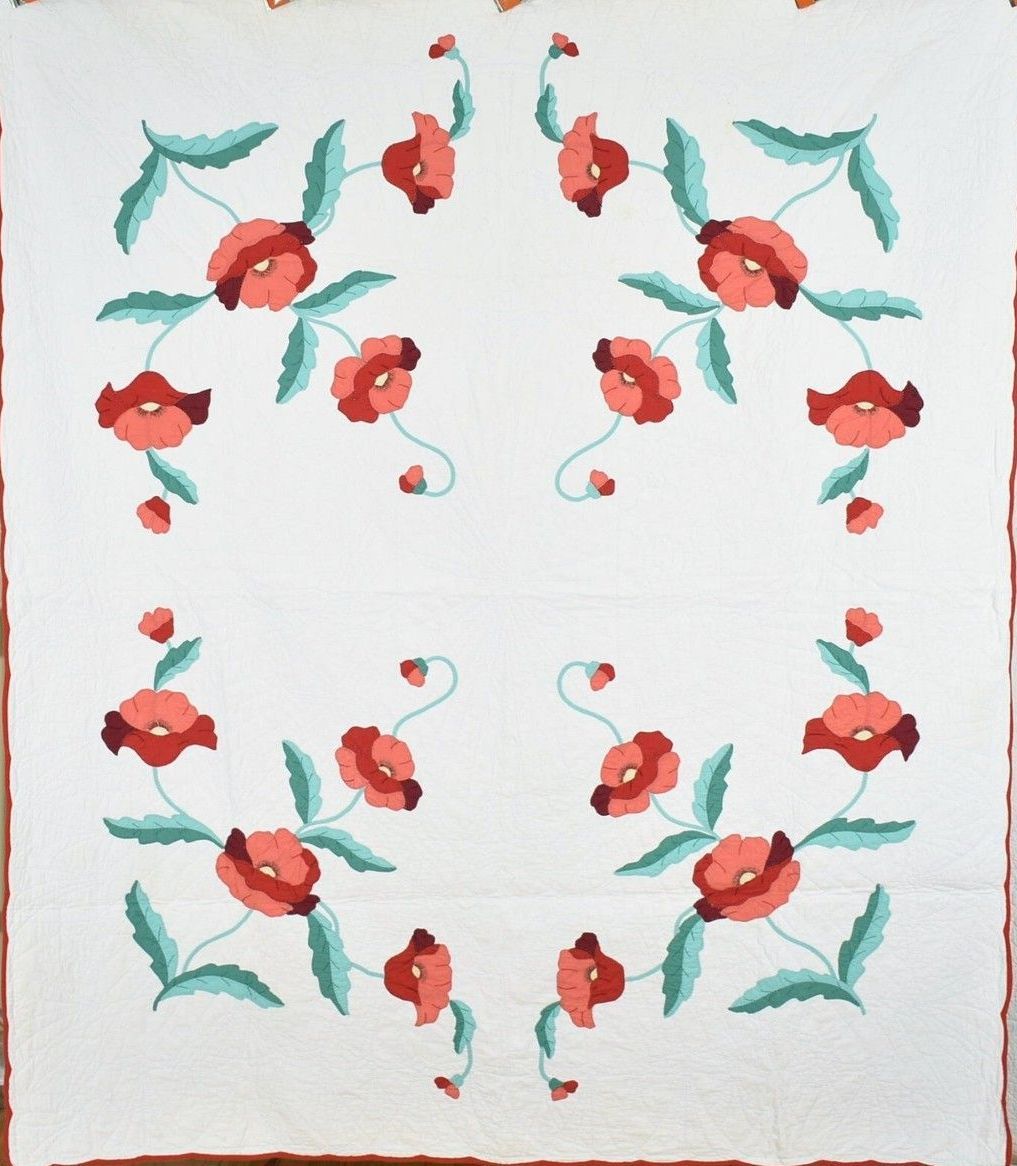
What: Review of Uncoverings 1995, Volume 16 of the Research Papers of the American Quilt Study Group, edited by Virginia Gunn Topic: “Marion Cheever Whiteside Newton: Designer of Story Book Quilts, 1940-1965” Author: Naida Treadway Patterson Born in 1902 into a wealthy, well-educated East coast family, Marion Cheever Whiteside Newton was educated in East coast schools and abroad. She studied art and was a successful watercolorist and muralist before becoming a successful designer of more than fifty applique quilt designs. Between 1940 and 1965 she “established and operated a cottage industry which produced quilt kits and ready-made quilts…through such magazines as Ladies’ Home Journal and Good Housekeeping.” [p. 67] Author Patterson’s extensive research and documentation of Whiteside Newton’s career covers a lot of material and highlights in detail many of Whiteside Newton’s design successes from paintings to quilt making. Her designs were in demand by celebrities from the movies as well as politicians as highly placed as the White House (notably, the Eisenhower era). [p. 74, 76] Patterson notes that Whiteside Newton’s “fascination with people in the process of daily life was reflected in her art, setting the stage for her future work.” [p. 71] She became particularly known for her Story Book Quilts which she copyrighted in 1941 and which were broadly inclusive of bible stories as well as popular literature like Little Women, Alice in Wonderland, Peter Rabbit, and others. [p. 73-77] Patterson notes that Whiteside Newton produced over three thousand Story Book quilts [p. 86] though most of these were likely made by a crew of skilled needleworkers, some of whom worked for her for many years. [p. 76] Patterson discusses and describes Whiteside Newton’s design methods and the organization of her research and development materials for each project. It is clear that Whiteside Newton was meticulous in her approach to each project, spending untold hours doing deeply-involved research to ensure her representations were as authentic as possible. Patterson also suggests several aspects to Whiteside Newton’s work that could do with further research. Having just returned from the 2025 AQSG Seminar in Portland, Maine, I can say that one of the study centers focused on the work of Marion Cheever Whiteside Newton’s work. Those present for the study center may have learned more about this interesting designer and producer’s work. Maybe some of them will speak up and enlighten us in a future Snippet’s column. Please feel free to contact me about what you learned. I’ll be glad to share your thoughts with readers. There are extensive Endnotes, and there are three appendices with lists of dates and publications in which patterns were featured or published, a list of photographs of completed story book quilts, and a list of additional pattern sketches.


November 6, 2025
What: Review of Uncoverings 1995, Volume 16 of the Research Papers of the American Quilt Study Group, edited by Virginia Gunn Topic: “Ruth Finley and the Colonial Revival Era” Author: Ricky Clark Clark’s abstract for this paper notes that Ruth Finley was born in Akron, Ohio, in 1884 and raised in Ohio’s Western Reserve. This region was originally a part of Connecticut’s 1662 charter that granted it land stretching west to the Pacific Ocean. After the Revolutionary War such land grant claims by Connecticut and other states were ceded to the U.S. federal government but Connecticut reserved a 120-mile strip of land in Ohio along Lake Erie as compensation. It was settled by New Englanders beginning in 1796 and the Reserve was incorporated into the state of Ohio upon statehood in 1803. [from Google search “Ohio’s western reserve” 10-25-25] It is Clark’s thought that having been raised in the Western Reserve by a large family of New Englanders, many of whom remained in New England, but exchanged visits frequently over the years, gave Ruth Finley a unique perspective on the Colonial Revival movement. Clark believes Finley’s early experiences and background and family influences “shaped the pattern and depth of scholarship that resulted in her classic book, Old Patchwork Quilts and the Women Who Made Them, first published in 1929…” [p. 33] Finley’s college career was short, only three semesters. In 1910 Finley became an investigative reporter for the Cleveland Press and made a name for herself investigating working conditions for Cleveland’s working class women. Into adulthood Finley followed the inclinations of her parents who had involved her in their own activities in national politics at an early age. She remained actively involved in Republican politics all her life, even editing the Women’s National Republican Club magazine, “the first national political review directed to women.” [p. 36] Finley also married Emmet Finley in 1910. He was also a reporter at the Press. Interestingly, both Ruth and Emmet participated in some paranormal work with Ruth being the receiver of messages from the beyond and Emmet being her transcriber/note taker. This is something they kept to themselves until she revealed it in her autobiography begun in 1951. [p. 37] Ricky Clark describes in great detail the professional and personal lives of Ruth and Emmet. She goes into particular detail about Ruth’s research and information-collecting practices as she began to delve into the Colonial Revival movement and quiltmaking. She had a strong preference for early quilt block patterns. She and a couple of family members and friends would take day trips “through the countryside looking at quilts airing on clotheslines, and buying some.” She also interviewed the women from whom she bought, probing for more information about quilt block names and stories about quiltmaking from earlier days. [p. 39] Clark details the development of the Colonial Revival movement noting that “The term ‘colonial,’ never historically accurate, could be seen as a code word for anti- or non-Victorian, anti- or non-modern…also profoundly anti-urban.” [p. 41] There is discussion of Finley’s interest in architectural styles of the region. And there are extensive descriptions of Finley’s deep interest in collecting “personal stories of the history and traditions associated with quilts, especially “sentimental stories.” [p. 45-48] Clark describes the family’s collection of letters, diaries, and artifacts from their earliest days in New England. These are the primary sources Finley was able to plumb for her scholarly research on Ruth Finley and there was much for her to plumb! The family was deeply interested in the lives of their ancestors, and they kept a lot of primary documents and artifacts. [p. 48-50] There is even reference to the fact that Ruth Finley owned Elizabeth Keckley’s Lincoln Quilt. It is a revealing story from which we get the cringe-worthy tale that well after Finley died, her grand-niece and -nephew took that quilt to their classroom show-and-tell. [p. 50] There is so much more interesting information in this well-researched and -written article. Clark’s scholarship is commendable. I recommend it to you all. And don’t fail to check out the Endnotes section. There are no less than 82 citations! Best wishes as we begin the holiday season. Talk to you again in December.
October 1, 2025
What: Review of Uncoverings 1995, Volume 16 of the Research Papers of the American Quilt Study Group, edited by Virginia Gunn Topic: “Origins and Traditions of Marseilles Needlework” Author: Kathryn W. Berenson Berenson consulted “commercial records, eighteenth-century paintings, inventories, textile artifacts, and written documents” to compile the research that resulted in this comprehensive overview of the history of Marseilles needlework. [p 7] It is a history that goes farther back into history than I imagined and includes influences from a wider range of cultures than I expected. Berenson places the earliest examples of Marseilles needlework in Provence in the Mediterranean at about 600 A.D. And, at the time of the Crusades records “show the presence of domestically produced or imported simple bedcovers stitched in diamond-grid motifs.” Furthermore, “by the end of the seventeenth century Marseilles needlework ateliers produced tens of thousands of domestic items stitched with delicate corded floral forms…” [p. 7] Despite such a rich and well established quilting industry Berenson notes that there is “no repository of information” on this tradition, “no dedicated literature, no museum with scholarly focus.” [pp. 7-8] Thus her reliance, as noted above, on other forms of documentation. Nevertheless, the results of her research are broad and broadly inclusive. Berenson details seventh century requests from the Pope for payment from “prelates in Marseilles and Arles to pay annual tribute in locally ‘worked cloth,’ not silver, so he could clothe his followers in Rome.” [p. 8] Merchant ships, crusading knights and pilgrims bought these textiles and clothing and dispersed them widely into Western Europe making the production and sale of these textiles a highly valued commodity, so much so that the Grand Council of Venice granted tax-free entrance to ships using “Marseilles-made sail canvas.” [p. 9] Berenson delves deeply into all of the influences upon the development of this needlework, the ways this needlework influenced events high and low, from kings to needleworkers all through the Mediterranean and Western Europe over hundreds of years. The effect of the shift from using silk to cotton by these needleworkers led to resistance from silk weavers in Lyon and that led to the use of these cottons being banned in France for some decades. The bans were flagrantly defied and eventually rescinded but many average people as well as nobles were affected in their everyday lives by these conflicts of interest. Berenson skillfully and succinctly describes all this. Most interestingly, she describes her sources and what they tell us. Her descriptions of supporting documents is like peeking behind the curtain of scholarship to watch a dedicated, maybe even obsessed, researcher at work. And it makes for page turning reading. There are several names for this kind of needlework that evolve over time and Berenson makes sure to describe them. Images help illustrate her descriptions. She also describes and discusses the published research of other scholars on this topic/, some of them former or current AQSG members. Finally, this report is richly supported by no fewer the 68 endnotes, some of which broaden the historical details in interesting ways. For example, note number 50 clarifies how the word boutis came to be applied to Marseilles needlework. Something I have wondered about. [p. 31] Read it all and enjoy. Best wishes for a great time at 2025 Seminar. See you there. If you see me stop me and let’s chat.
Read More

See Yourself in AQSG!

Featured Publication

Uncoverings

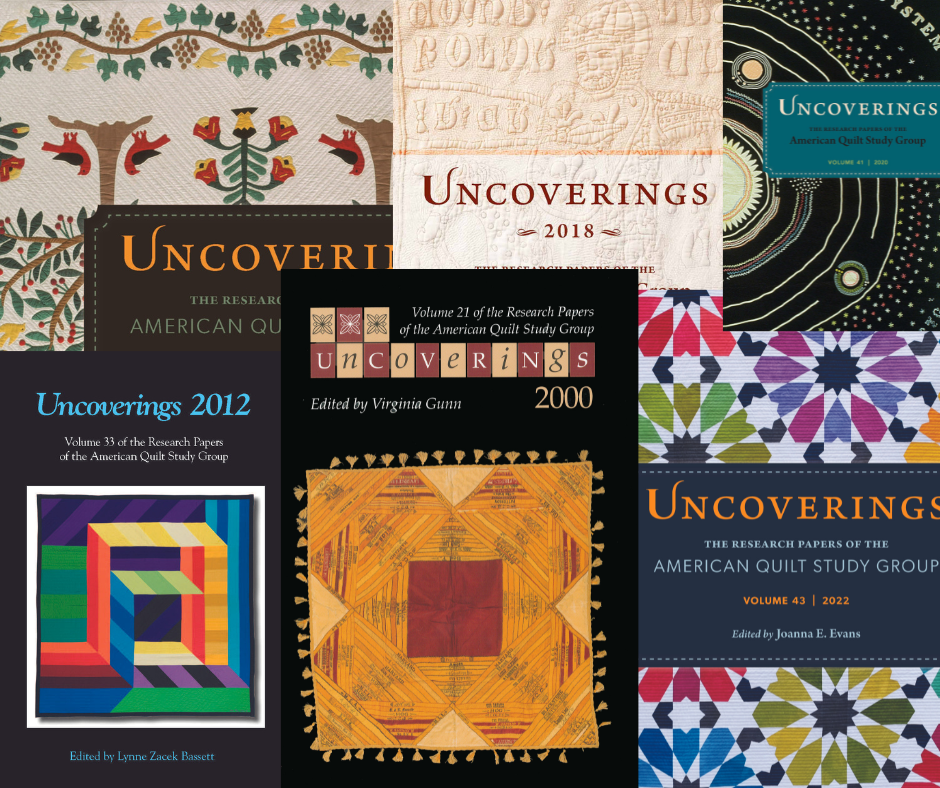
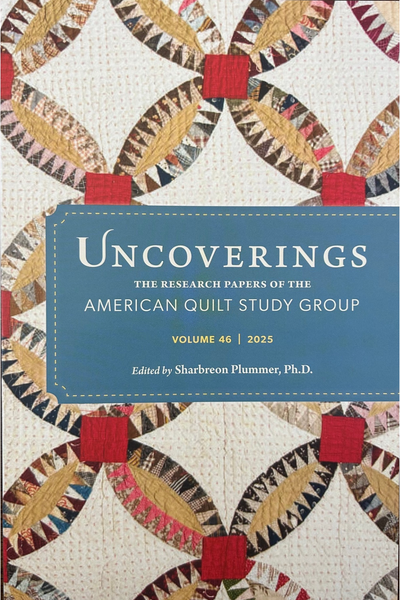
Uncoverings, the annual peer-reviewed journal of AQSG, features papers that present the most recent advances in quilt-related research. The cover of Volume 45 (2024) is The Mary Worrall Parry quilt, 1844-1845, and is inscribed with the names of a small group of families that were friends and neighbors in the Ridley Township, Delaware County, in southeast Pennsylvania. Photo courtesy of Cathy Erickson; photograph by Jennifer Charbonneau.

Uncoverings

Sponsors and Partners

We warmly thank our sponsors and partners for their generous support.