Taking Quilt Study

into the Future

American Quilt Study Group (AQSG) connects quilt enthusiasts through research and community. We study, collect, and enjoy textiles ranging from the earliest quilt fragments to studio art and modern quilts.

Learn More

Playing Now on YouTube

What is Material Culture?

Visit the AQSG Youtube Channel

Quilt History Snippets

Articles by AQSG members featuring interesting quilts, makers, or patterns they have come across in their research.

February 6, 2026
What: Review of Uncoverings 1995, Volume 16 of the Research Papers of the American Quilt Study Group, edited by Virginia Gunn Topic: “Marketing Quilt Kits in the 1920s and 1930s” Author: Xenia E. Cord In this thoroughly researched and documented report Cord credits the role of “commercially produced and media-promoted” kit quilts for, to some degree, “the resurgence of quiltmaking during the Colonial Revival movement of the 1920s and 1930s. In the process these early twentieth century commercially made kits standardized and “redirected the focus of quiltmaking from a community-based folk group process to a professionally created product stressing surface design.” [p. 139] The improvisational style we see in so many mid- to late nineteenth century quilts was replaced in the early years of the twentieth century by a small group of “designers, manufacturers, and marketers, and were promoted through media and commercial sources as a reaffirmation of women’s domestic and artistic skills.” In her research Cord found a secretive “tangle of corporate interconnections, layered informal associations, widespread duplication of printed material and often obscured sources for the kits themselves.”[p. 139-140] Cord begins her documentation of these changes declaring that the creators and advertisers “created, guided, and molded the scope and direction of…quilt kit buyers with their visual and emotional appeal[s].” [p. 141] In the evolutionary process of their marketing and quilt kit production, “kit purveyors became the arbiters of style, in some instances replacing or suggesting alternatives to the standards of the traditional quiltmaking community.” The “industry created national standards for performance, and national rather than regional pattern names and designs.” [p. 142] How all this was done and by whom is the source considerable documentation and discussion that follows Cords early declarations. There are names of participants in the quilt kit industry and vivid descriptions of marketing practices. Illustrations are included as well as an extensive reference section with very inclusive and informative end notes. Cord ends her report with a number of questions and suggestions for future research on this topic noting “Considering the position of importance kit quilts assumed in the continuum of quilt history, this review of the marketing methods and sources during the first quilt revival of the twentieth century can only point the way to more extensive research.” [p. 166] It can be hoped that there are students of quilt history who are interested in taking up the charge. Xenia Cord’s article would be a great place to start.

January 8, 2026
What: Review of Uncoverings 1995, Volume 16 of the Research Papers of the American Quilt Study Group, edited by Virginia Gunn Topic: “The Origin of Mountain Mist® Patterns” Author: Merikay Waldvogel This is a trailblazing and jam packed article full of revealing information based on primary sources to which Waldvogel had, in 1995, recently been given access. The letters dating from the late 1920s to very early 1930 between a Tennessee artist and the sales manager of Stearns & Foster Co. of Cincinnati, Ohio (producers of Mountain Mist batting) revealed previously unknown details and answered questions for not only Waldvogel, but many others who had been looking for information on why and who designed and produced the “wrapper patterns” enclosing Mountain Mist batting. Reading this article was a bit like reading a Nancy Drew mystery, and great fun it was. One wonders if she felt the same way at the time. Waldvogel notes that “Collectors have long prized the wrappers as well as the other printed matter, which, until now, have been the only sources of information about the company.” And the discovery of the correspondence “provides a detailed record of the company’s plan to promote quiltmaking (and the sales of its cotton batting) through the distribution of high-quality quilt patterns. [p. 95] Later in the article, Waldvogel notes that the sales manager even directed the artist to make her illustrations display the designs in solid-colors rather than prints. [p. 125-126] The manager was Frederick J. Hooker, Sales Manager of the Putnam-Hooker Batting Department of Stearns & Foster Co. The artist was Margaret Hays of Chattanooga, Tennessee. “They shipped watercolor sketches and finished pattern layouts back and forth between Ohio and Tennessee for eight months from July 1929 through February 1930.” [p. 96] Hays’ niece, Evelyn Hays Banner, “inherited the materials and contacted Waldvogel thinking they might be important to quilt research.” [p. 96] And this is the key to why it was so important. There were no known extant records about this business relationship between Hooker and Hays. The company’s current staff believed “such records were discarded when a series of new owners took over the company in the mid-twentieth century.” [p. 96] Waldvogel describes in interesting detail how she validated the information she found in the correspondence. She provides images of letters and designs. Importantly, she states, “The company’s efforts impacted the quilt revival of the 1930s.” And, that the “new information suggests that the changes in style, color, and construction associated with Depression Era quilts did not happen by chance.” [p. 98] It can all be credited to the marketing practices at Mountain Mist! Waldvogel traces the history of the company from its founding in 1846 when they began experimenting with ways to make a batting that “would not tear or stretch.” [p. 98] Packaging was but one of the ways the company’s employees experimented and innovated and promoted their products and packaging. And there were many product names used over the years. Also, there were multiple designer names used in the promotion of Mountain Mist designs over the years. Hay’s name apparently was not one of them! There is so much good and interesting information in this article that I cannot recommend it enough to all of you. The End Notes are extensive. There are several appendices with trademark names and dates, quilt pattern names and dates, as well as company publication names and dates. If you are looking for information on Depression Era quilt patterns/designs and dates, or information on the Mountain Mist patterns this is the source for you. Best wishes for the new year. We’ll review another article next month. You can contact me at kmoore81@austin.rr.com for more information and comments.

December 2, 2025
What: Review of Uncoverings 1995, Volume 16 of the Research Papers of the American Quilt Study Group, edited by Virginia Gunn Topic: “Marion Cheever Whiteside Newton: Designer of Story Book Quilts, 1940-1965” Author: Naida Treadway Patterson Born in 1902 into a wealthy, well-educated East coast family, Marion Cheever Whiteside Newton was educated in East coast schools and abroad. She studied art and was a successful watercolorist and muralist before becoming a successful designer of more than fifty applique quilt designs. Between 1940 and 1965 she “established and operated a cottage industry which produced quilt kits and ready-made quilts…through such magazines as Ladies’ Home Journal and Good Housekeeping.” [p. 67] Author Patterson’s extensive research and documentation of Whiteside Newton’s career covers a lot of material and highlights in detail many of Whiteside Newton’s design successes from paintings to quilt making. Her designs were in demand by celebrities from the movies as well as politicians as highly placed as the White House (notably, the Eisenhower era). [p. 74, 76] Patterson notes that Whiteside Newton’s “fascination with people in the process of daily life was reflected in her art, setting the stage for her future work.” [p. 71] She became particularly known for her Story Book Quilts which she copyrighted in 1941 and which were broadly inclusive of bible stories as well as popular literature like Little Women, Alice in Wonderland, Peter Rabbit, and others. [p. 73-77] Patterson notes that Whiteside Newton produced over three thousand Story Book quilts [p. 86] though most of these were likely made by a crew of skilled needleworkers, some of whom worked for her for many years. [p. 76] Patterson discusses and describes Whiteside Newton’s design methods and the organization of her research and development materials for each project. It is clear that Whiteside Newton was meticulous in her approach to each project, spending untold hours doing deeply-involved research to ensure her representations were as authentic as possible. Patterson also suggests several aspects to Whiteside Newton’s work that could do with further research. Having just returned from the 2025 AQSG Seminar in Portland, Maine, I can say that one of the study centers focused on the work of Marion Cheever Whiteside Newton’s work. Those present for the study center may have learned more about this interesting designer and producer’s work. Maybe some of them will speak up and enlighten us in a future Snippet’s column. Please feel free to contact me about what you learned. I’ll be glad to share your thoughts with readers. There are extensive Endnotes, and there are three appendices with lists of dates and publications in which patterns were featured or published, a list of photographs of completed story book quilts, and a list of additional pattern sketches.
Read More

See Yourself in AQSG!

Featured Publication

Uncoverings

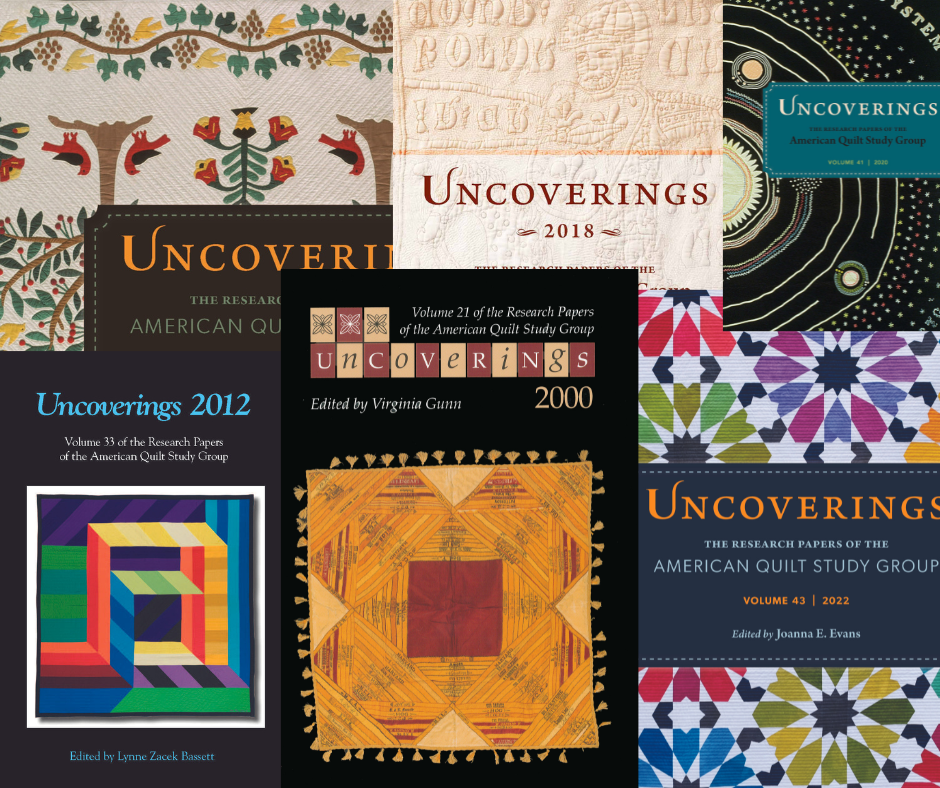
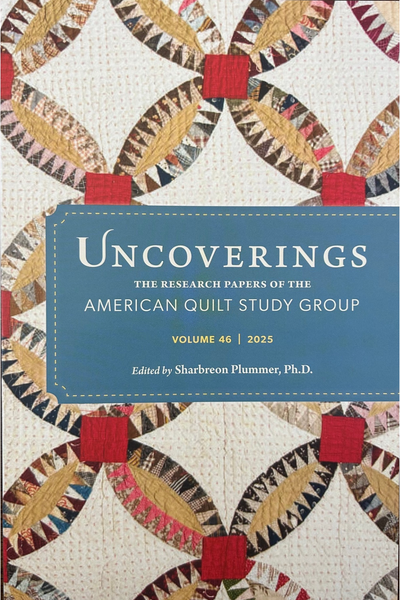
Uncoverings, the annual peer-reviewed journal of AQSG, features papers that present the most recent advances in quilt-related research. The cover of Volume 46 (2025) is  Pickle Dish, 82 x 72 inches, gifted to Lucy Hilty by Julie Silber and Linda Reuther, Mary Strickler's Quilt,  mid 1980s, San Rafael, CA. Photo courtesy of San Jose Museum of Quilts and Textiles. 

Uncoverings

Sponsors and Partners

We warmly thank our sponsors and partners for their generous support.